Spin the Wheel: onboarding culture as a game
New starters usually meet a company's culture as a stack of policies. I turned it into a game of chance they actually want to play. This is the real, finished Storyline prototype. Play it below.
The question I set myself: how do you get new staff to understand a company's culture and the behaviours it expects, in a way they actually remember?
The problem
Most organisations hand new starters a stack of policies and procedures and call it onboarding. To me that is a wasted opportunity. Nobody remembers a behaviour because they read it in a document. They remember it because they made a decision, saw what happened, and had a moment to reflect on it. So I wanted to replace passive reading with active choices, without losing the substance a new starter genuinely needs.
The idea
Make it a game. And because almost nobody can resist a game of chance, make it a wheel. The whole experience is carried by one big red button: press it, the wheel spins, and you land on a category. I built eight, including a wild card, so the culture is broken into the areas that actually shape day-to-day behaviour: Communication, Ethics, Risk, Innovation, Sustainability, Budget, Teamwork, and the Wildcard.
How it works
Every spin runs the same loop, which is what makes it feel like a game rather than a course:
- Spin the wheel. The big red button lands the learner on one of the eight categories, so no two runs feel quite the same.
- Face a real scenario. Each category opens a realistic situation from the job, not an abstract policy statement.
- Make a choice, get honest feedback. The learner decides how to respond and sees the consequence of that choice, so the learning is judgement, not recall.
- Land on a Takeaway. Each scenario ends on a short Remember and Reflect, the bit that makes the point stick and carries onto the job.
- Back to the wheel. On to the next spin, collecting professional points along the way, and finishing on a proper celebration. Yes, there is disco music and a dancer, because onboarding is allowed to be fun.
How it's built
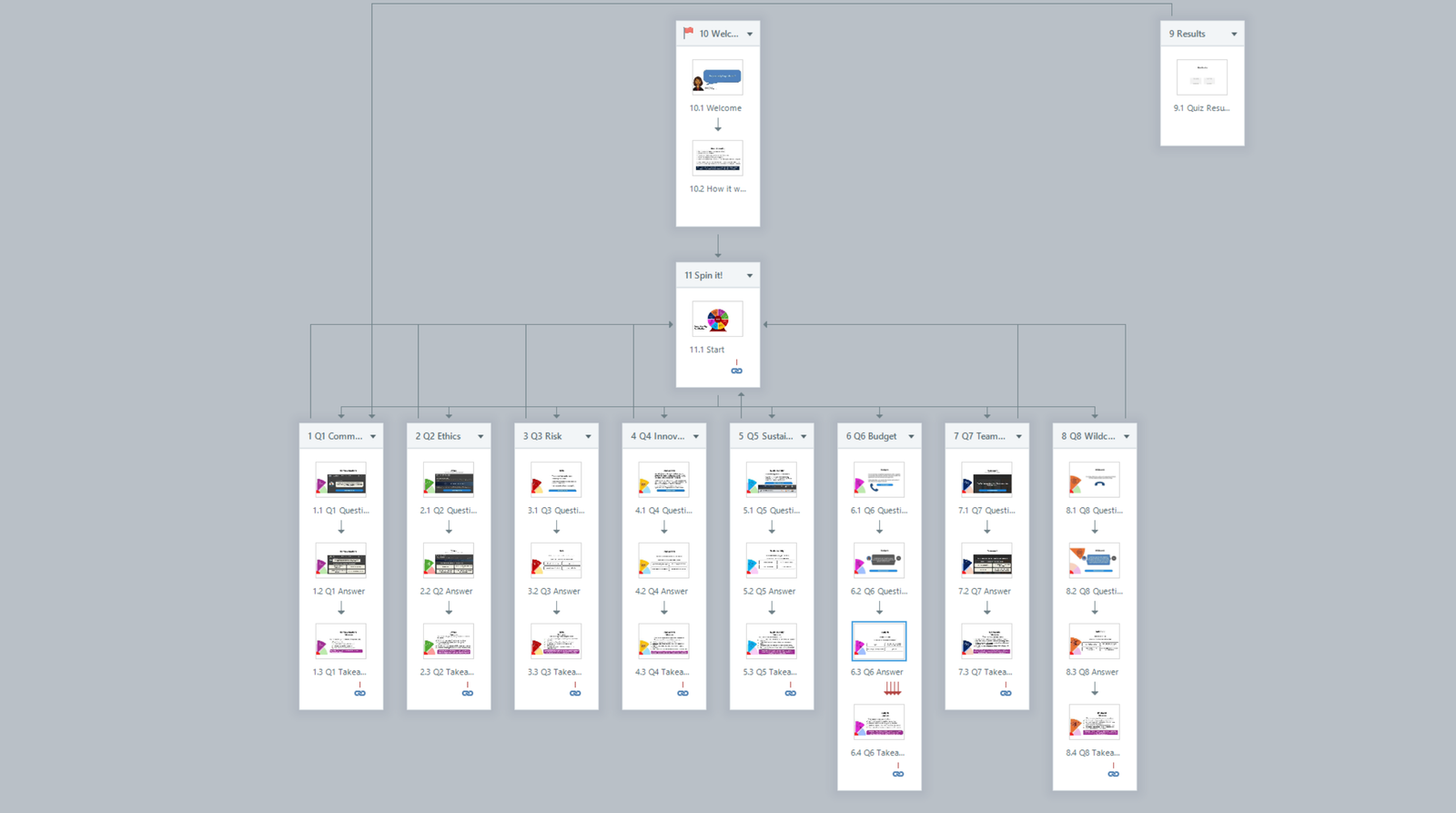
This is the story view from Storyline: every scene, every branch, laid out flat. Eight categories, each running the same set-up, question, answer and takeaway pattern, all wired back to one wheel. It looks complicated on the map. It never feels that way when you are playing it, which was the whole point.
Why it works
The randomness keeps it playful and gives every learner a slightly different path through the same content. The scenarios teach the behaviours the way people actually learn them, by deciding and seeing the result. The Remember and Reflect Takeaways turn each spin into something a new starter keeps. And it is built in Storyline with captions throughout, so the whole intake can access it, however they learn best. It is the difference between onboarding people sit through and onboarding that shows them, on day one, what good looks like here.
Learning that changes behaviour, not just tick boxes. Even onboarding.